
What Is Plaster?

Plaster coats walls and ceilings, protecting them or adding decoration. It also helps mold decorative parts. Makers mix binders – like lime, gypsum, or cement – with water. This creates a fine paste that leaves a smooth, even surface. Over time, plaster has gotten harder, thanks to better kiln firing methods.
This material works as a thin cover and as a finish. Workers often put on two coats, inside and out. It protects stone, brick, and concrete walls. Plaster of Paris – a gypsum plaster – mostly goes indoors because it dries so smoothly.
What Is Concrete?

Concrete is a basic building material. It comes from cement, sand, gravel, or other fine and coarse aggregates, and water. This forms a mixture of aggregate, filler, and binder.
At first, concrete feels flexible and semi-liquid; you can mold it into many shapes. Later, it hardens into a tough, rock-like substance. We use it for foundation walls, concrete slabs, and patios.
It’s a complete building material – often reinforced with steel, it has a certain grade and structural strength. Its strength and durability make it the most common man-made material in the world.
How Do Plaster and Concrete Differ?
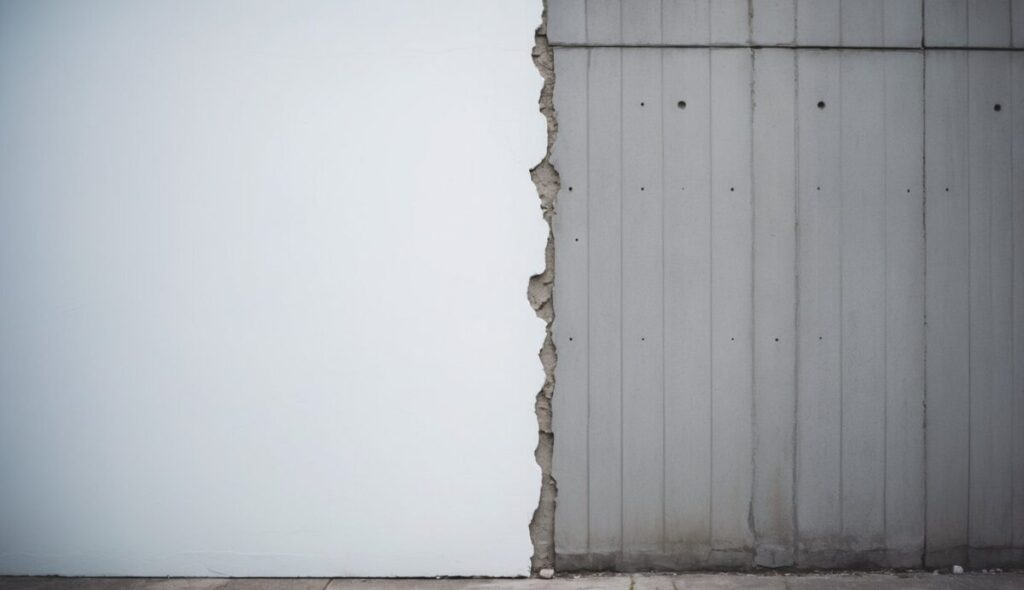
Plaster and concrete are distinct construction materials. They have different compositions, applications, and specific strengths. Both have been used since antiquity, mixing up historical differentiation because of varied ingredient proportions.
Knowing these differences helps make construction and renovation projects both durable and good-looking.
Compositional Differences and Aggregates
Concrete includes cement, crushed sand, and aggregate – gravel or stones. It also has water, which carries both fine and coarse aggregates.
Plaster usually skips the coarse aggregate; it’s made from lime (or gypsum – calcium sulfate) and water, or cement and fine sand. Mortar, found in some plasters, mixes cement, fine sand, and water.
Primary Applications and Structural vs. Finish Role
Concrete gives structures strength. It makes up foundations, slabs, columns, and beams.
Plaster, on the other hand, is a finishing material. Workers spread it on walls and ceilings as a protective or decorative layer.
So, concrete forms the structure; plaster finishes the surface.
Strength and Hardness Comparison
Concrete is considerably stronger and more durable than plaster. It is engineered to reach a specific level of structural integrity, which makes it the go-to material for foundations and load-bearing structures. Its strength comes from the combination of coarse aggregates held together by cement.
Plaster, though it does harden into a solid surface, is much weaker in comparison to concrete.
When to Use Plaster?
Builders use plaster when a surface needs to look good, stay protected, or be insulated. It offers a fast, simple way to finish many surfaces. Plastering smooths things out – perfect for decorative finishes.
You get soundproofing, better insulation, and fire resistance, all from plaster. Cement-based plasters even work as spray-on fireproofing. Plaster gives a tough, smooth, and good-looking finish, hiding bad materials, sloppy work, rough areas – any construction flaws. This forms a flat base for primer and paint.
Achieving Smooth Decorative Finishes
Plaster makes walls and ceilings smooth and decorative. It evens out surfaces, hides flaws, and primes walls for paint. You can choose from many plaster finishes: smooth cast, roughcast, sand-faced, scrapped, or textured designs. Getting a truly smooth finish usually means applying three coats.
Plaster also offers an industrial look, much like polished concrete. This works for both indoor and outdoor spaces. For swimming pools, special pool plaster – a mix of Portland cement and sand – forms a hard, white, smooth surface. It improves how the pool looks and lets you add mosaic tiles.
Providing Surface Protection and Insulation
Plaster shields many surfaces, offering protection and insulation. It makes walls tougher and stops rain from getting in. This material also helps with soundproofing, keeps heat in, and resists fire. Some cement plasters, for instance, work as spray fireproofing products.
Sand-faced plaster creates a waterproof layer. Plaster in swimming pools is like a ¾ inch layer of thick mortar – on the inside. It blocks water from getting through. But you must maintain this protection regularly.
Molding and Casting
Plaster is a great material for molding decorative items. It shows up in indoor displays a lot, cast into molds to get those fancy designs. Plaster shapes and hardens easily, which makes it perfect for many architectural details and art pieces. Concrete also works in molds, but people often choose plaster for indoor decorative casting – the kind that doesn’t need to hold up a building. Why? It has a finer texture and is simple to work with for small details.
When to Use Concrete?
Concrete works for jobs needing strong foundations, walls, and columns. It carries heavy loads and lasts a long time. Builders use it for its strength and durability. This material – made of cement, sand, aggregate, and water – also holds up well outside, resisting rough weather.
Forming Structural Elements
Concrete forms the backbone of many structures. We use it for foundation walls, slabs, columns, and beams. This material provides real strength – often working with steel as the main load-bearer. Concrete pours easily, then hardens into a strong, rigid mass. This makes it perfect for building tough structural parts.
Creating Durable Foundations and Surfaces
Concrete anchors things. It helps build lasting foundations and surfaces, strong and long-lived. This material works for patios, driveways, and other masonry jobs. For pools, concrete makes the shell. Then, an interior finish – plaster, aggregate, or tile – seals it from water and makes it look good.
Aggregate finishes use river pebbles, stone, or glass mixed into Portland cement plaster. These last longer than plain plaster – 15 to 20 years – and resist chemical damage. Glass tile gives pools another tough, beautiful look. Plaster costs the least for pool interiors, but it only lasts 5-10 years. It also needs more cleaning because of stains and algae.
Concrete’s toughness even suits industrial finishes. Environmentally friendly versions exist, like Portland Pozzolana Cement (PPC). PPC lasts longer and lets less water through than Ordinary Portland Cement (OPC).